

NZ & Australian Law Granny Flats, 2nd Dwellings Add ons Effetive 2026.

New Zealand’s Revolutionary 70sqm Granny Flat Law: Everything You Need to Know
A Game-Changer for Housing Affordability and Property Development
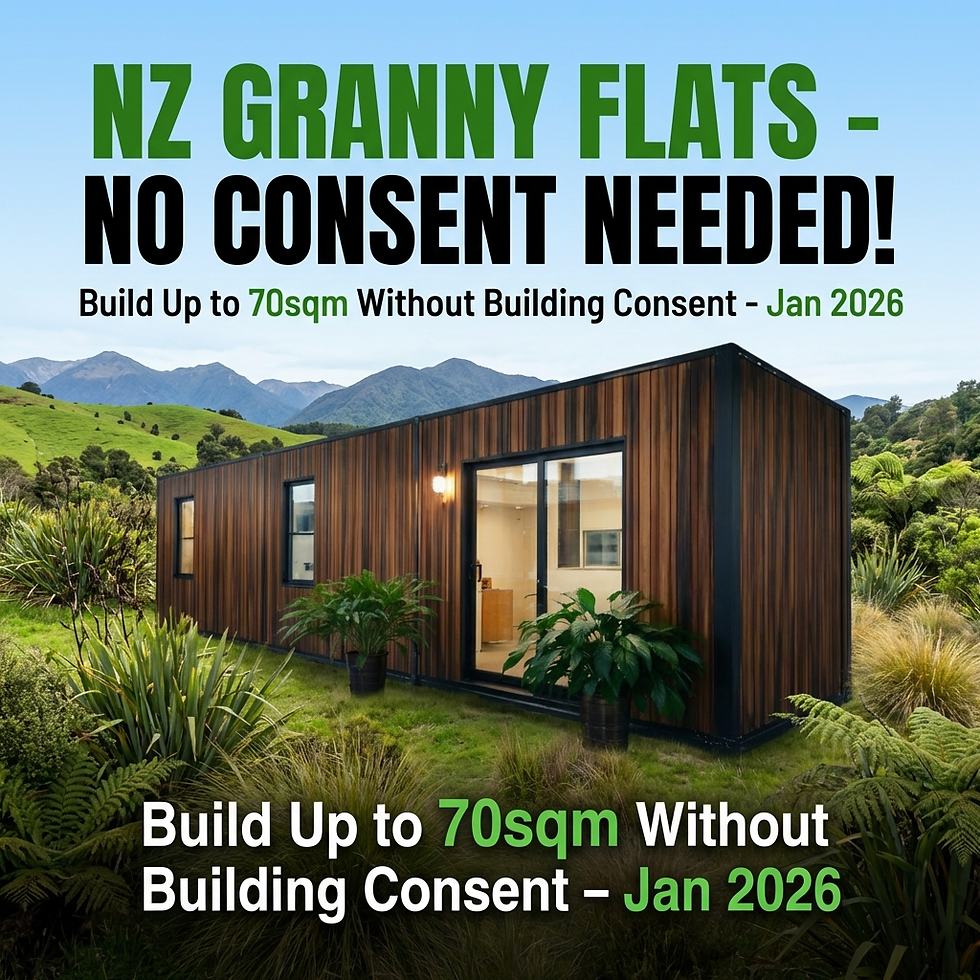
New Zealand has taken a bold step toward addressing its housing crisis with groundbreaking legislation that came into effect on 15 January 2026. Under Schedule 1A of the Building Act 2004, homeowners can now build standalone dwellings up to 70 square metres without requiring a building consent—a move that has the potential to reshape the country’s housing landscape and provide affordable accommodation options for thousands of Kiwis.
Understanding the New Legislation
The “granny flats exemption,” as it’s commonly known, allows eligible small standalone dwellings to be constructed without the traditional building consent process, provided they meet specific design, construction, and site conditions. This represents a significant departure from New Zealand’s historically rigorous building consent regime and aims to fast-track the delivery of secondary dwellings across the country.
The legislation specifically targets what are often called granny flats, minor residential units, or secondary dwellings—small homes typically used to accommodate elderly parents, adult children, provide rental income, or serve as home offices and guest accommodations.

Key Requirements: What Qualifies for the Exemption?
To take advantage of the building consent exemption, your proposed granny flat must satisfy all of the following conditions:
Design and Construction Standards
The dwelling must be new, standalone, and single-storey only. This means you cannot convert existing structures, build multi-level units, or attach the dwelling to your main house. The maximum floor area is capped at 70 square metres, including any internal garages, ensuring the structure remains classified as a “small” dwelling.
Construction must utilize lightweight steel or timber framing with lightweight roof cladding. This requirement ensures structural safety while maintaining the spirit of simple, accessible construction. Importantly, the design cannot include level-entry showers that require waterproof membranes—a specific technical exclusion that affects bathroom design choices.
The structure must maintain a minimum distance of 2 metres from other buildings and property boundaries, ensuring adequate separation for fire safety, maintenance access, and neighbour amenity. The design must also be straightforward—no waivers or modifications to the Building Code are permitted under this exemption.
Site and Service Requirements
Your property must have appropriate utility connections. The granny flat must connect to public stormwater and wastewater networks, or alternatively, have a compliant on-site water and drainage system that meets regulatory standards.
Critically, the land must not be affected by natural hazards such as flooding, landslip, or earthquake-prone characteristics. This protects both homeowners and future occupants from building in unsuitable locations where safety could be compromised.
Professional Oversight: Not a DIY Exemption
One of the most important aspects of this legislation is that it is NOT a do-it-yourself exemption. All work must be carried out or supervised by Licensed Building Practitioners (LBPs). This ensures that despite the absence of formal building consent, construction quality and safety standards are maintained through professional oversight.
Restricted building work—such as structural framing, foundation work, and building envelope installations—must be performed by appropriately licensed professionals. This requirement protects homeowners from substandard construction and maintains the integrity of New Zealand’s building standards.
What You Still Need to Do
While the building consent requirement has been removed, this is not a completely consent-free process. Homeowners must still navigate several regulatory requirements:
Project Information Memorandum (PIM)
Before starting construction, you must apply for and receive a Project Information Memorandum (PIM) from your local council. This is a mandatory requirement, not optional. The PIM provides information about the property, identifies any potential issues, and confirms the proposed work meets exemption conditions.
In Auckland, the PIM base fee is $520, though costs may vary by council and additional charges may apply for complex assessments.
Other Necessary Approvals
You must obtain network utility approvals for connections to water, electricity, stormwater, and wastewater systems. If you’re creating new driveway access, vehicle crossing approvals are required.
Importantly, you must still comply with the Resource Management Act and meet local land use restrictions. The new Resource Management (National Environmental Standards for Detached Minor Residential Units) Regulations 2025 provide supporting framework, but you should verify specific requirements with your local council.
Documentation and Records
Upon completion, Licensed Building Practitioners must submit Records of Work to the council. This includes Form 2A for design work and Form 6A for building work, along with sanitary plumbing and drainlaying records. Any applicable development contributions must also be paid.
What’s NOT Included in the Exemption
Understanding what doesn’t qualify is equally important:
Renovations or conversions of existing structures
Multi-storey buildings (must be single-storey)
Attached structures (must be standalone and detached)
Buildings exceeding 70sqm (even by one square metre)
Buildings on hazard-prone land
DIY builds without Licensed Building Practitioner supervision
Complex designs requiring Building Code modifications or waivers
The Rationale: Why This Law Matters
New Zealand faces a severe housing affordability crisis, with property prices and rents putting enormous pressure on families and individuals. This legislation addresses multiple challenges simultaneously:
Increasing Housing Supply: By making it easier to add secondary dwellings, the law enables more efficient use of existing urban land without requiring greenfield development.
Multi-Generational Living: With an aging population, many families want to accommodate elderly parents close by while maintaining privacy and independence for all parties.
Affordable Housing Options: Granny flats provide lower-cost rental accommodations in established neighbourhoods with existing infrastructure and amenities.
Income Generation: Homeowners can create rental income streams through long-term tenancies or short-term platforms like Airbnb, helping with mortgage payments and retirement planning.
Streamlined Processes: Reducing regulatory complexity and timeframes makes housing development more accessible to average homeowners, not just large developers.
Important Considerations and Warnings
Insurance and Resale Implications
Non-compliance with exemption conditions can seriously affect your property insurance. Insurers may refuse claims or coverage if structures don’t meet required standards. Similarly, non-compliant buildings can impact property resale value and title, with potential buyers requiring evidence of compliance before purchase.
Enforcement Still Applies
Councils retain the power to take enforcement action for non-compliant work. Penalties apply for breaching exemption conditions, and building work must still meet the Building Code even without formal consent.
Professional Costs Remain
While you save on building consent fees and associated delays, you still need to budget for Licensed Building Practitioner fees, PIM costs, utility connection charges, and development contributions. The exemption streamlines the process but doesn’t eliminate professional involvement costs.
Looking Forward
This legislation represents a significant shift in New Zealand’s approach to housing regulation—balancing the need for safety standards with the imperative to increase housing supply quickly and affordably. Early estimates suggest the potential for 50,000+ new granny flats over the next three to five years, adding substantial accommodation capacity without massive infrastructure investments.
For homeowners considering a granny flat, the message is clear: this is an exciting opportunity, but it requires careful planning, professional guidance, and strict adherence to all remaining regulatory requirements. The exemption simplifies the process but doesn’t eliminate the need for quality construction, proper documentation, and regulatory compliance.
As New Zealand continues grappling with housing challenges, this law offers a practical, scalable solution that empowers individual homeowners while maintaining essential safety standards—a promising step toward more affordable, accessible housing for all Kiwis.

Australian Granny Flat Laws: A State-by-State Guide to Secondary Dwellings
Navigating the Complex Landscape of Dual Occupancy Regulations Across Australia
Australia’s housing affordability crisis has prompted governments across the nation to reform planning laws to encourage secondary dwellings, commonly known as granny flats or dual occupancies. However, unlike New Zealand’s unified national approach, Australia’s federal system means each state and territory has developed its own regulatory framework, creating a complex patchwork of rules that vary significantly depending on your location.
What is a Granny Flat in Australian Law?
In Australian planning terminology, a granny flat is typically defined as a self-contained dwelling that is ancillary to a primary residence on the same lot. These structures go by various names depending on the jurisdiction: secondary dwellings (NSW), dependent persons units (Queensland), ancillary dwellings (Western Australia), or simply granny flats in common usage.
Legally, granny flats are distinguished from other secondary structures like sleepouts, studios, or home offices by their inclusion of full living facilities—typically a kitchen, bathroom, sleeping area, and living space. This self-contained nature makes them suitable for independent living while remaining secondary to the main dwelling.
New South Wales: Leading Reform
New South Wales has implemented some of Australia’s most progressive granny flat regulations, reflecting the acute housing pressures in Sydney and regional centres.
Complying Development Framework
Under the State Environmental Planning Policy (Exempt and Complying Development Codes) 2008, homeowners in NSW can build granny flats as “complying development” without requiring full development approval, provided they meet specific criteria:
Size Limitations: The maximum gross floor area is 60 square metres for properties under 450sqm, and up to 60 square metres plus an additional 5% of the lot area for larger properties (capped at 100sqm in certain circumstances).
Location Requirements: The granny flat must be located on the same lot as the principal dwelling, positioned in the rear or side yard, and maintain minimum setbacks from boundaries (typically 900mm).
Design Standards: Maximum height is generally 8.5 metres with restrictions on building over easements, minimum private open space requirements (generally 16sqm), and compliance with relevant Australian Standards.
Use Restrictions: Critically, NSW regulations prohibit granny flats from being sold separately or strata subdivided from the primary dwelling. They can be rented, but rental agreements must be informal family arrangements or registered granny flat arrangements under specific legal frameworks.
Building Approvals Still Required
While NSW’s complying development pathway streamlines planning approval, all granny flats still require building approvals through a private certifier or council. Construction must comply with the National Construction Code (NCC) and all relevant Australian Standards.

Victoria: State-Specific Variations
Victoria’s approach to secondary dwellings is less uniform than NSW, with significant variations between metropolitan Melbourne and regional areas.
Planning Permit Requirements
In Victoria, most granny flats require a planning permit from the local council. The assessment considers:
Zoning Regulations: Different residential zones have varying provisions for secondary dwellings. General Residential Zones typically allow two dwellings per lot, while Neighbourhood Residential Zones are more restrictive.
Design Standards: ResCode (Residential Development Standards) applies, assessing neighbourhood character, overlooking, overshadowing, private open space, and vehicle access.
Size Considerations: While there’s no state-wide maximum size limit, local planning schemes often cap secondary dwellings at 60-80 square metres, though this varies significantly by municipality.
Building Permits
Like all states, Victorian granny flats require building permits and must comply with the NCC. Bushfire-prone areas have additional requirements under bushfire management overlays.
Queensland: Dependent Person Focus
Queensland’s regulations historically focused on accommodating dependent family members, though this is gradually evolving.
Development Assessment
Secondary dwellings in Queensland are typically called “dependent persons units” or “secondary dwellings” depending on use and council area.
Accepted Development: Some councils allow secondary dwellings as “accepted development” (no approval needed) if they meet strict criteria—typically limited to very small structures (under 40-50sqm) or specific zones.
Code Assessable Development: Most granny flats require development approval as “code assessable development,” assessed against planning scheme codes covering:
Maximum floor area (commonly 60-70 square metres)
Setback requirements from boundaries
Parking provisions (usually one space minimum)
Design compatibility with neighbourhood character
Infrastructure capacity
Building Approvals
Building approval from a private certifier or council is mandatory, with compliance to NCC and Queensland-specific building regulations required.
Western Australia: Conservative Approach
Western Australia maintains relatively conservative regulations around secondary dwellings, though recent reforms have increased flexibility.
Planning Approval Requirements
Secondary dwellings (called “ancillary dwellings” in WA planning documents) generally require development approval unless specifically exempted by local planning schemes.
Size Restrictions: Maximum gross floor area typically capped at 70 square metres in most metropolitan local government areas.
Relationship Requirements: Many WA councils require the property owner to occupy either the primary dwelling or the ancillary dwelling—preventing purely investment-focused dual occupancy developments.
Design Standards: Residential Design Codes (R-Codes) govern setbacks, building height, open space, and parking, with specific provisions varying by R-Code density classification.
Building Permits
Building permits through the Building Commission are mandatory, with full NCC compliance required.
South Australia: Flexible Framework
South Australia offers moderate flexibility for secondary dwellings within established planning frameworks.
Development Approval Process
Secondary dwellings typically require development approval unless they qualify under specific exemptions:
Deemed-to-Satisfy Provisions: Small ancillary buildings under certain size thresholds (often 20-30sqm) may not require approval if they lack full living facilities.
Performance Assessed Development: Granny flats are generally assessed as “performance assessed” development, evaluated against planning policies covering site coverage, setbacks, parking, and design quality.
Size Guidelines: While no uniform state limit exists, most councils apply practical limits around 60-80 square metres for secondary dwellings.
Building Rules Compliance
Building approval under SA’s building rules is mandatory, with certification required for completion.
Australian Capital Territory: Streamlined Process
The ACT has implemented relatively streamlined processes for secondary dwellings reflecting Canberra’s planned urban development approach.
Development Approval
Secondary dwellings (often called “ancillary units”) are generally permissible development in residential zones, requiring:
Development Application: Most proposals require DA approval unless meeting very specific exempt criteria.
Size Limits: Typically restricted to 90 square metres maximum gross floor area.
Design Compliance: Territory Plan requirements cover setbacks, building height, landscaping, and parking provisions.
Northern Territory and Tasmania: Case-by-Case Assessment
Both the Northern Territory and Tasmania handle secondary dwellings primarily through local council planning schemes without extensive state-wide frameworks, resulting in highly variable requirements depending on specific municipal areas.
Universal Requirements Across Australia
Despite state variations, certain requirements apply universally:
National Construction Code Compliance
All Australian granny flats must comply with the National Construction Code (NCC), covering:
Structural adequacy and safety
Fire safety provisions
Health and amenity standards
Energy efficiency requirements (minimum 6-star rating in most jurisdictions)
Accessibility provisions where applicable
Waterproofing and weatherproofing standards
Building Approvals Always Required
No Australian jurisdiction allows granny flats without building approval. This contrasts with New Zealand’s recent exemption and reflects Australia’s continued emphasis on building safety oversight.
Utility Connections
All granny flats require proper connections to:
Water supply (town water or approved tank systems)
Wastewater disposal (sewerage or approved septic systems)
Electricity supply with compliant installations
Stormwater management systems
Title Restrictions
Across all Australian jurisdictions, granny flats generally cannot be subdivided or sold separately from the primary dwelling. They remain legally part of the same title as the main house, preventing strata subdivision of traditional suburban lots.
Financial and Legal Considerations
Costs and Budgeting
Building a compliant granny flat in Australia typically costs between $100,000-$250,000 depending on size, location, specifications, and site conditions. Budget considerations include:
Planning and development application fees ($500-$3,000)
Building permit fees ($1,000-$5,000)
Professional design fees (architects, engineers: $5,000-$15,000)
Construction costs ($1,500-$3,000 per square metre)
Utility connection fees ($5,000-$20,000)
Landscaping and site works
Rental Income and Taxation
Granny flats can generate rental income of $250-$500+ per week depending on location and quality, providing significant financial returns. However, tax implications include:
Rental income is assessable for tax purposes
Capital gains tax implications if property subsequently sold
Potential loss of principal place of residence CGT exemption on portion of property
Negative gearing opportunities where expenses exceed income
Insurance Requirements
Separate insurance consideration is essential:
Building insurance must cover both dwellings adequately
Landlord insurance for rental situations
Public liability coverage
Disclosure requirements to insurers about secondary dwelling
Recent Trends and Future Directions
Australian governments are increasingly recognizing secondary dwellings as crucial tools for addressing housing affordability. Trends include:
Regulatory Streamlining: More jurisdictions moving toward complying development frameworks similar to NSW.
Size Increases: Gradual increases in maximum permitted sizes reflecting modern living standards.
Pre-Approved Designs: Some councils offering pre-approved designs expediting approval processes.
Modular and Prefabricated Options: Growing acceptance of factory-built solutions meeting building code requirements.
Laneway Housing: Emerging provisions for rear-lane accessed secondary dwellings in inner-city areas.
Conclusion: Know Your Local Rules
Australia’s fragmented approach to granny flat regulation means there’s no one-size-fits-all answer. Property owners must research specific requirements in their state, territory, and local government area before proceeding. While this complexity can be frustrating, engaging experienced professionals—town planners, building designers, and certifiers—ensures compliance and protects your investment.
The overarching message is clear: Australian granny flats require proper planning and building approvals in all circumstances, but when done correctly, they offer valuable housing options and financial benefits for homeowners navigating the country’s challenging property market.
Comments