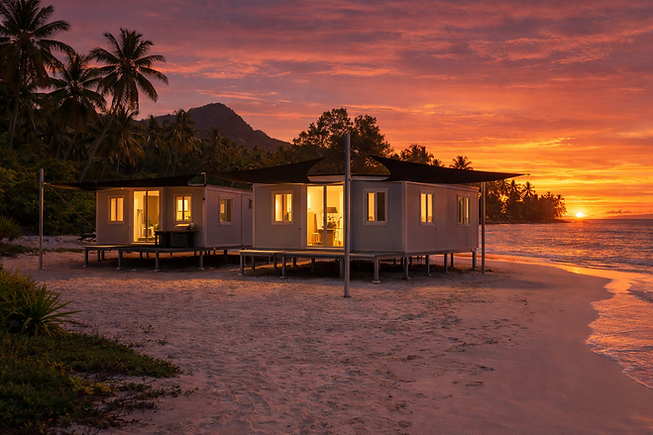
So Where do we start?
(Give me the details)

So How Does this Work? In Detail
Full Buying Cycle for a Pacific Islands Expandable Home (End‑to‑End)
Buying a 20FT–40FT expandable home from China for the Pacific is not a single purchase—it’s a managed cycle with checkpoints. The aim is simple: lock the specification early, control quality before shipment, and arrive on‑island with the right documents, the right build, and a clear installation plan.
1) Define the Outcome (Before Any Quote)
Start by clarifying what “success” looks like for the island site:
-
Location exposure: coastal salt air vs inland, cyclone history, wet-season intensity
-
Intended use: family home, staff accommodation, rental/Airbnb, emergency housing
-
Site constraints: access for crane/forklift, foundation type, utilities (water/septic/power)
-
Compliance target: which national standard set you’re aiming to satisfy (this affects plumbing/electrical detailing)
This prevents “quote drift” where the supplier assumes a generic build while your market needs storm and waterproofing upgrades.
2) Choose the Model & Configuration (20FT / 30FT / 40FT)
Confirm the physical configuration, because it drives shipping, installation sequence, and technical detailing:
-
Footprint and layout (e.g., 2BR vs 3BR)
-
Roof option (e.g., apex roof) and outdoor living (e.g., balcony/patio roof)
-
Window/door configuration and ventilation strategy
A simple way to keep decisions clean: treat the base unit as fixed, and use an “Island Upgrade Pack” for storm + waterproofing + service access.
3) Freeze Specifications (The “Sign‑Off Pack”)
This is the most important professional step in the cycle: a written, supplier‑agreed pack that includes:
-
Dimensions (expanded + folded), layout drawing, and finishing schedule
-
Structural materials (steel grade, galvanising, fasteners)
-
Envelope (panel thickness, skins, insulation, roof build-up)
-
Electrical routing approach (conduit, moisture protection, junction box rating)
-
Plumbing sizes and drainage fall requirements (and maintenance access strategy)
If you change specs after production starts, cost and delays typically multiply—so you want a structured sign‑off moment before welding and panel assembly.
4) Contracting & Payment Milestones (Risk-Controlled)
Typical production contracts use:
-
Deposit to begin (50%)
-
Balance before loading/shipping
Best practice for a first-time import is to tie payments to proof points:
-
Signed drawings/spec schedule
-
Photos/videos at key production milestones
-
Pre-shipment inspection evidence
-
Final packing list and container loading photos
5) Production Phase (Factory Build + QC)
During production you want “repeatable verification,” not general updates.
A strong workflow mirrors the three-stage control logic used in Dracon’s compliance-style approach: pre‑production confirmation, in‑process checks, and pre‑shipment verification .
Ask for:
-
Material verification photos (panel labels, steel sections, galvanised finish, window/door glass markings)
-
Waterproofing interface photos (joints, roof penetrations, balcony connections)
-
Electrical and plumbing rough-in photos before walls are closed
6) Storm + Waterproofing Upgrades (Applied as a System)
Upgrades must form a continuous performance chain:
-
Roof-to-wall load path (tie-down strategy)
-
Expandable section lateral bracing
-
Ground anchoring approach
-
Cyclonic window/door reinforcement pathway
-
Roof fastener and washer system
-
Structural wall reinforcement (where required)
-
Expandable joint sealing and overlap plates
This is especially relevant for Pacific deployments where wind-driven rain and uplift failures are common during storm events.
7) Drainage, Serviceability, and “Future Repairs”
A home that cannot be serviced becomes expensive to own. Prioritise:
-
Correct pipe sizing for toilet waste (market-appropriate diameter)
-
Drain line slope verification so waste flows reliably
-
Long-sweep fittings and correct junction geometry (reduces blockage risk)
-
Access panels at critical points so pipes can be cleared or replaced without tearing up floors
Your existing technical diagrams are ideal to keep suppliers aligned:
-
Pipe upgrade diagram (75mm vs 100mm)
-
Drainage slope requirement diagram
-
Raised bathroom platform solution diagram
-
Access panel layout diagram
8) Shipping & Export Documentation (Where First-Time Buyers Get Stuck)
Shipping is not only “freight.” The shipment must clear both export and import steps smoothly. Ensure you have:
-
Commercial invoice + packing list
-
Container details and seal number
-
Any required treatment certificates (as applicable)
-
A document pack prepared for your customs broker
Also plan for “port reality”: low-volume islands can have variable schedules and trans-shipment dependencies.
9) Arrival, Customs Clearance, and Site Logistics
Most on-island delays come from:
-
Missing/incorrect paperwork
-
Not having a broker ready
-
Not having transport and lifting booked in advance
Before the vessel arrives, confirm:
-
Who is your broker
-
Who is collecting from port
-
Whether you need a crane, forklift, or hiab truck
-
The final site access route and turning space
10) Installation & Commissioning (Treat It Like a Handover)
Installation success is repeatable when you follow a commissioning checklist:
-
Foundation levels and anchoring points confirmed
-
Expansion/unfold sequence controlled
-
Roof and guttering installed and water-tested
-
Electrical RCD/leakage protection tested
-
Plumbing pressure test and drainage flow test
-
Waterproofing check at all expandable joints and wet areas
11) After-Sales: Warranty, Maintenance, and Future Orders
A professional cycle includes the “operational phase”:
-
Maintenance plan for galvanised steel in salt air (inspection intervals)
-
Sealant re-check schedule after first wet season
-
Consumable spares list (locks, hinges, gasket lengths, spare fasteners)
-
A feedback loop that updates the next order’s sign-off pack
This is how you go from “first unit” to “repeatable program” across Tonga/Cook Islands and other Pacific destinations.